
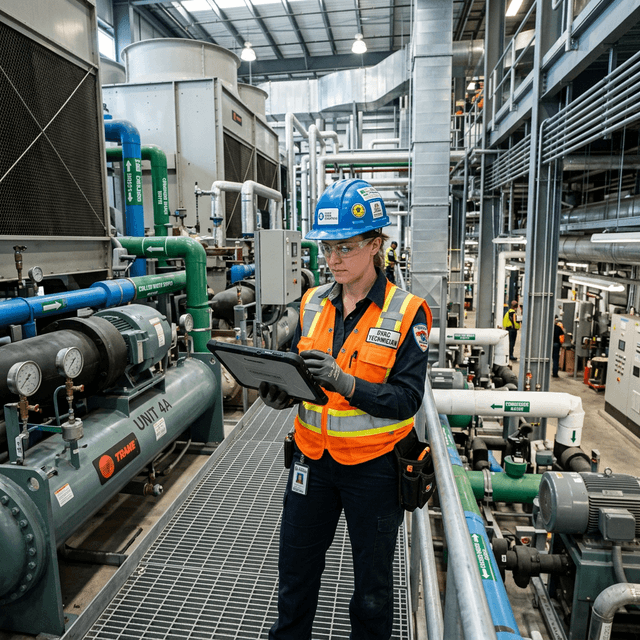
Unplanned HVAC downtime in an industrial setting can cost hundreds of thousands of dollars per hour in lost production. Implementing a rigorous preventative maintenance (PM) protocol is not optional — it is a core operational strategy.
A best-in-class PM program for large-scale industrial cooling systems covers four pillars: mechanical integrity, refrigerant circuit health, electrical system reliability, and control logic calibration. Each pillar must be addressed on a defined schedule, not reactively.
Mechanical inspections should include bearing lubrication cycles, belt tension verification, and compressor vibration analysis using accelerometers. Refrigerant circuit health requires quarterly pressure and superheat/subcooling checks to detect micro-leaks before they escalate. Electrical work covers terminal torque, contactor wear, and VFD parameter drift — a common cause of efficiency degradation. Finally, control logic must be re-calibrated seasonally to account for changing ambient conditions, ensuring the system's PID loops remain optimally tuned.
Key Technical Takeaways
- Quarterly refrigerant pressure audits prevent undetected leaks
- VFD parameter drift accounts for up to 15% efficiency loss if uncorrected
- Seasonal PID re-calibration maintains peak thermodynamic performance
- Structured PM programs reduce total lifecycle cost by up to 35%
Access Industrial Whitepapers
Join 500+ lead engineers receiving our bi-weekly thermodynamic research and system optimization guides.
Related Insights

The Future of VRF Systems in High-Rise Architecture
A deep dive into variable refrigerant flow logic and its application in modern megalopolis structural cooling.
Thermal Management in Desert Environments
Technical challenges and solutions for maintaining structural cooling when external temperatures exceed 50°C.
How Air Conditioners Work: The Science of Absolute Cooling
Ever wondered how a box can transform scorching desert heat into refreshing indoor comfort? Let's break down the refrigeration cycle step-by-step.